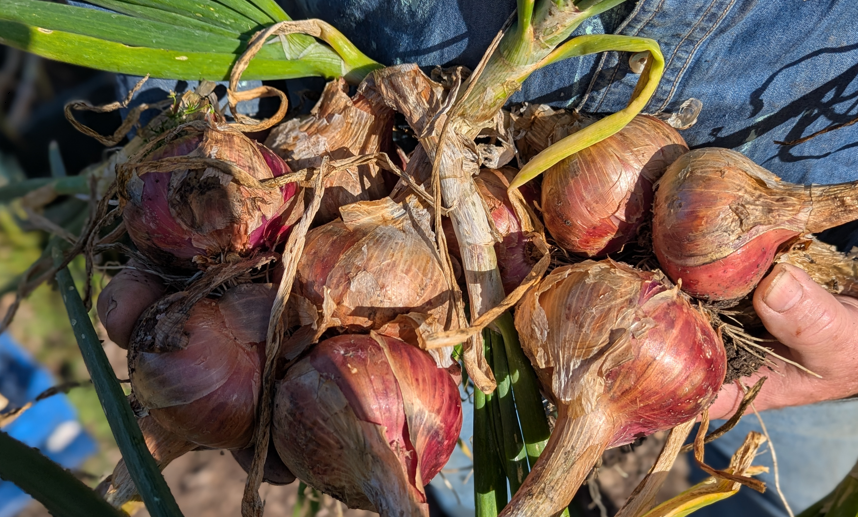
Things are really starting to look promising in the Potato Onion project. In the spring of the 2025 growing season I had been left with nearly 20 reasonable Potato Onion bunches from the 2024 season. Some were simple pairs of bulbed onions of reasonable size but a few others were triples. Nearly all of the 2024 season Potato Onions I stored in the previous autumn made it through the winter when stored in an unheated outdoor shed. The attrition rate (onions going soft and mushy over the winter) was probably only about 10%. The ones that made it through formed the
Category 3 Potato Onions for the 2025 season.
Thus the split onions of the 2024 breeding season, along with onions grown from seed in that year, formed the basis for the 2025 years plantings. The bunches from 2024 were separated into two groups - taking care to make sure each group had at least one representative from each harvested bunch. In the early spring of 2025, one group was planted in the bed of a greenhouse for breeding purposes. The second group was planted outdoors in a garden bed. The greenhouse planting is necessary because outdoor alliums will set seed in my location but the seed heads will not ripen properly. The onion bulbs grown from seed in the 2024 season (they never split in their first year) were all planted outdoors.
One of the primary characteristics of the onions I wished to test was whether the setting of seed inhibited the splitting of the onion into bulbs. A secondary test was to determine if the onions which set seed would have the bulb go soft and mushy as one would typically expect from a biennial. Unlike the 2024 season, only the onions intended for seed were allowed to grow scapes and set seed heads.
All of the onions, whether indoors or outdoors, attempted to produce scapes. This is not too surprising since this was their second or third year.
Probably about 60% of the onion bulbs split and produced secondary and tertiary bulbs. It did not seem to matter if the onions were planted indoors or outdoors. I am not sure if the bulbs which did not split indoors were from the same bunch as the ones which did not split outdoors. I do not keep records of that fine a granularity. My philosophy runs something like
"plant them out, see what you get, cull the unsuitable ones and plant out the best next year".
Interestingly, the bulbs which were prepared to split all started to noticeably split well before they set scapes. This allowed me to snip off the scapes of the non-splitting ones and let just the onions prepared to split into twos, threes and fours set seed and hence cross in with each other. This was done to remove the non-splitting ones from this years gene pool.
Unlike in the 2024 season, very few of the original bulbs planted seemed to go soft and mushy. For most, it did not matter if they set seed or not or if they split or not. The original bulbs just seemed to remain intact and, if they split to produce a new bulb, the new bulb (or bulbs) appeared to be identical in size shape and firmness to the original.
The bulbs grew well, both indoors and outdoors, into fine large-ish onions. I am not sure if 2025 was just a good year for them or if the plants themselves improved year on year since the remaining bulbs no longer seem to degrade in typical biennial fashion. As mentioned earlier, all of the onions that split in the greenhouse were also allowed to produce seed heads. That seed has now been collected and will be used as the basis for the 2026 spring planting.
Category 3 Onions
The Potato Onions at the end of the 2026 season are shown below (click on any pic to enlarge). First up - the triple and quadruple bulbs
Here we can see the doubles. There are quite a number of them this year. The white bar in the center of the images is a measuring stick with both centimeter and inch markings.
As you can see, there are about 11 or so Potato Onion bunches which split into triples and quadruples and another 19 or so which split into two. Recall that these onion bunches are either the output a single bulb which also split in the summer of 2024 or the result of a single onion grown from seed in 2024 and hence in 2025 was beginning its second year. As I mentioned earlier, in most cases the original bulb survived and appears to still be quite viable. If my results prove true in future years, these onions do seem to have some sort of perennial characteristics. The jury is still out on this one as in previous years most of the original bulbs did not seem to survive to be harvested after splitting.
Here are some images of onions which were grown from seed starting in the spring of the 2025 season. As you can see they are gratifyingly large and healthy looking. I take this as an indication that continued selective breeding is improving my seed stock - but it may just have been a good year. The ones that make it through the winter will go back out in the garden in the spring of 2026 to see if they split.
Salad Onions
In the 2024 season some of the onions planted from seed ended the season as quite small single bulbs. These were too small to be considered to be viable potato onions and would normally have been culled. However, in the thought that they might split in subsequent years, I replanted them out in 2025 to see what might happen. In fact, some did split. The image below shows the results.
These onions stayed small and many just set seed and died - but a certain percentage split rather nicely. I think I will take these as a starting point and work on them separately in order to see if I can produce a line of perennial spring onions/scallions/bunching onions for salads and such. No point in letting interesting genes go to waste just because the results were not quite what you originally were looking for.
Future Plans
For the 2026 year I am going to try a number of things. Since I have so much seed this year I have scattered some it in the late autumn in a now unused bed of a greenhouse. This seed has already sprouted and the onions are in the "grass" stage. The hope is that they survive the winter and save me the trouble of germinating the seed in the spring as well as getting a better head start on things.
The other thing I will do for the 2026 season is to take a percentage of the onions and plant them outdoors in the garden beds in the late autumn of 2025. The idea here is to observe how they cope with an outdoor overwintering and if they will still split and set seed. I am looking for any data points I can get and now that the number of bulbs is climbing up I can afford to make experiments that might loose them.
Eventually I would like to prove out a "method of work" where, in the autumn, you harvest a bunch of 3 or 4 good sized onions all derived from a single bulb planted in the spring. At that point you would immediately break off one of the bulbs - plant it back in the bed and consume the remainder. The replaced bulb would then overwinter, grow, split and form the basis of the following years bunch. This would effectively be a self generating onion set and would eliminate a lot of work.
All in all, 2025 has been a good year for the Potato Onion Project. The fact that the onions now in progress have proven that they will readily set seed and still split is a big positive. It makes working with them so much easier. Historically, potato onions are notoriously reluctant to produce viable seed.
You may also wish to view the
2024 Potato Onion Report and the
2023 Potato Onion Report.